

Every now and then – and it’s always on Fridays – a company pops up with a press release so full of dazzling, world-changing promises that you have to sit down, have a biscuit, and read it again just to be sure. This week, that company is Tensor, and they’ve just announced what they’re calling the “world’s first personal autonomous vehicle,” the Robocar. It’s not a car adapted to drive itself; it’s a robot built from the ground up that also happens to have wheels. And you, a regular person, are supposed to be able to buy one. Awesome.
That elusive promise of self-driving cars has been dangled in front of us like a particularly juicy carrot for what feels like an eternity. The reality, so far, has been a bit less “sit back and read the paper while being chauffeured through Paris” and a bit more “keep your hands near the wheel and pray it doesn’t get confused by a plastic bag.” Most autonomous efforts we see are for robocab fleets – vehicles that live in a depot and are fussed over by an army of technicians every night. Tensor is saying, “No, no, that’s all wrong.” They want to sell you a car that lives in your garage, drives you to work, and doesn’t need a babysitter.
To achieve this, they’ve apparently bolted every sensor known to mankind onto this thing. Get ready for the list, it’s long. The Tensor Robocar has 37 cameras, 5 LiDAR units, 11 radars, 22 microphones, 10 ultrasonic sensors, and a whole host of other gizmos. I think my house has fewer sensors, and it’s supposed to be a “smart” home. The company says this gives it “uncompromised visibility.” I should hope so. With that many eyes, it could probably spot a fly trying to land on a satellite. They’ve even engineered it with radar-transparent materials and dedicated wipers to keep the lenses clean. It even has little covers that protect the key sensors when it’s parked, like a sleepy owl closing its eyes.
The brain behind all this hardware is an AI that Tensor says is a “game-changer.” It’s not based on a rigid set of “if-this-then-that” rules. Instead, it learns from data, much like we do. It has two systems working together: System 1 is your gut reaction, the part that slams the brakes when a squirrel runs out. System 2 is the thoughtful part that reasons its way through a tricky, unmarked intersection in the pouring rain. By combining both, Tensor claims its Robocar can handle not just the predictable but also the weird stuff life throws at you.
And since this is the marketing department speaking, they’re calling it the world’s first “AI agentic vehicle.” Essentially, it’s not just a car, it’s a companion. You can talk to it, text it, or even wave at it. It’s powered by a Large Language Model, the same kind of tech that lets you ask an AI to write a poem about your cat. The idea is that the car learns your preferences and acts on your behalf. This is either the pinnacle of convenience or the beginning of a sci-fi movie where my car refuses to let me go to a fast-food joint because it knows I’m on a diet.
What’s the horsepower? What’s the battery capacity? How far will it go on a charge? How fast does it get to 60 mph? How big is it? After reading through all the talk of “embodied personal agents” and “multimodal LLMs,” I can tell you that the answer to all of those questions is… a shrug. They haven’t mentioned a single one. It’s like announcing the world’s most advanced new airliner and forgetting to say how many people it can carry or how far it can fly. They’ve told us everything about the robot, but almost nothing about the car.
Image Credit: Tensor.
What they have told us about the interior is quite clever, I’ll admit. Because this is a “Dual Mode” vehicle – meaning you can choose to drive it yourself or be driven – they’ve done something rather neat. When you’re in autonomous mode, the steering wheel folds away, and the display screen slides to a better position for you to do whatever you’ll be doing. It creates a genuinely different space. Whether you’ll be using that space for important business or just a jolly good nap remains to be seen.
On the more serious fronts of safety and privacy, Tensor seems to be ticking the right boxes. The entire system is built with full redundancy – backup power, backup controls, backup everything – to prevent a single point of failure from causing a catastrophe. And for all you privacy advocates, the company swears that all your data, like where you’ve been and what you’ve said, is processed and stored locally on the vehicle. No Big Brother in the cloud watching your every move. There are even physical covers for the in-cabin cameras and a switch to turn off the microphones, for those moments when you need to have a truly private conversation or, more likely, sing along terribly to the radio.
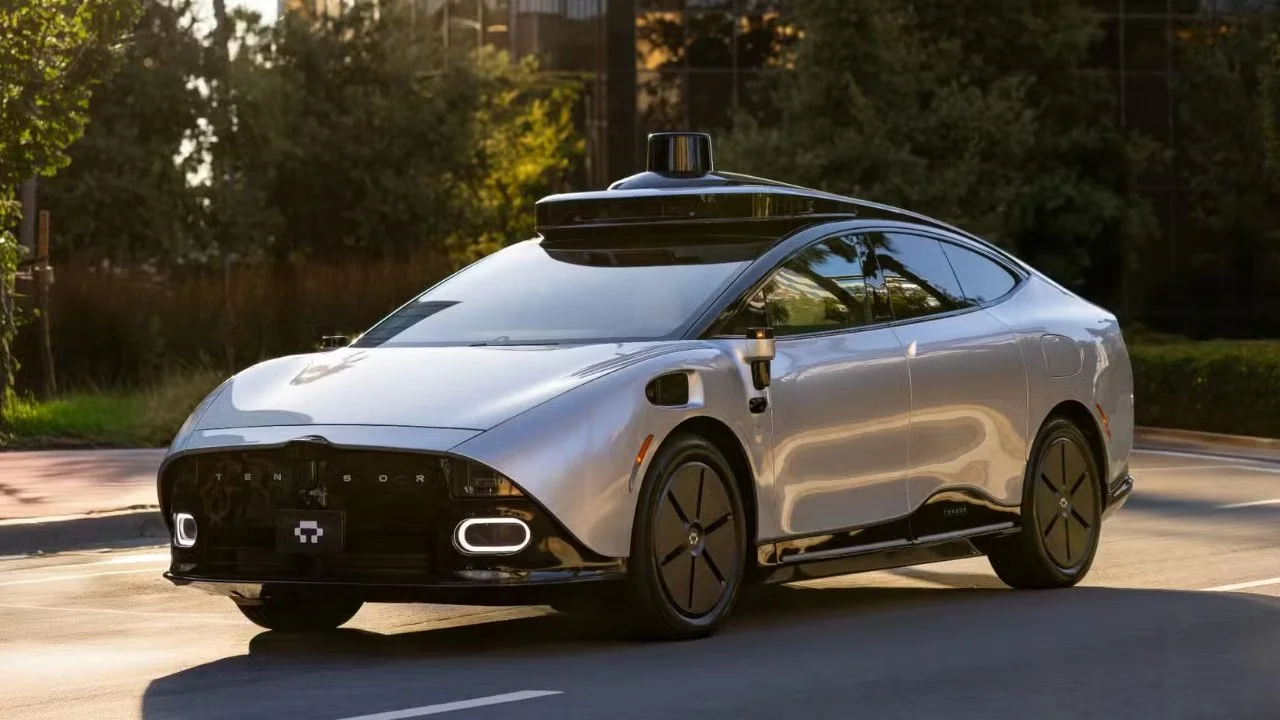
Image Credit: Tensor.
Of course, a small startup from Silicon Valley isn’t building this monolith in a shed. They’ve assembled an all-star team of partners. The supercomputer brain is powered by NVIDIA, the manufacturing will be handled by VinFast in Vietnam, and they’ve partnered with a who’s who of automotive suppliers like Bosch, ZF, and Continental. There’s some serious industrial muscle behind this dream.
What’s the verdict? The Tensor Robocar is either the most significant leap in personal transportation since the horse decided to retire, or it’s the most ambitious piece of vaporware we’ve seen in years. It’s an electrifying concept, packed with technology that sounds like it was lifted from a blockbuster film. But it’s also a car with no specs. The promise of true freedom – where your vehicle is a partner, not a tool – is huge. Deliveries are already planned for the second half of 2026, but until that day comes, I’ll remain where I always am: skeptical.