
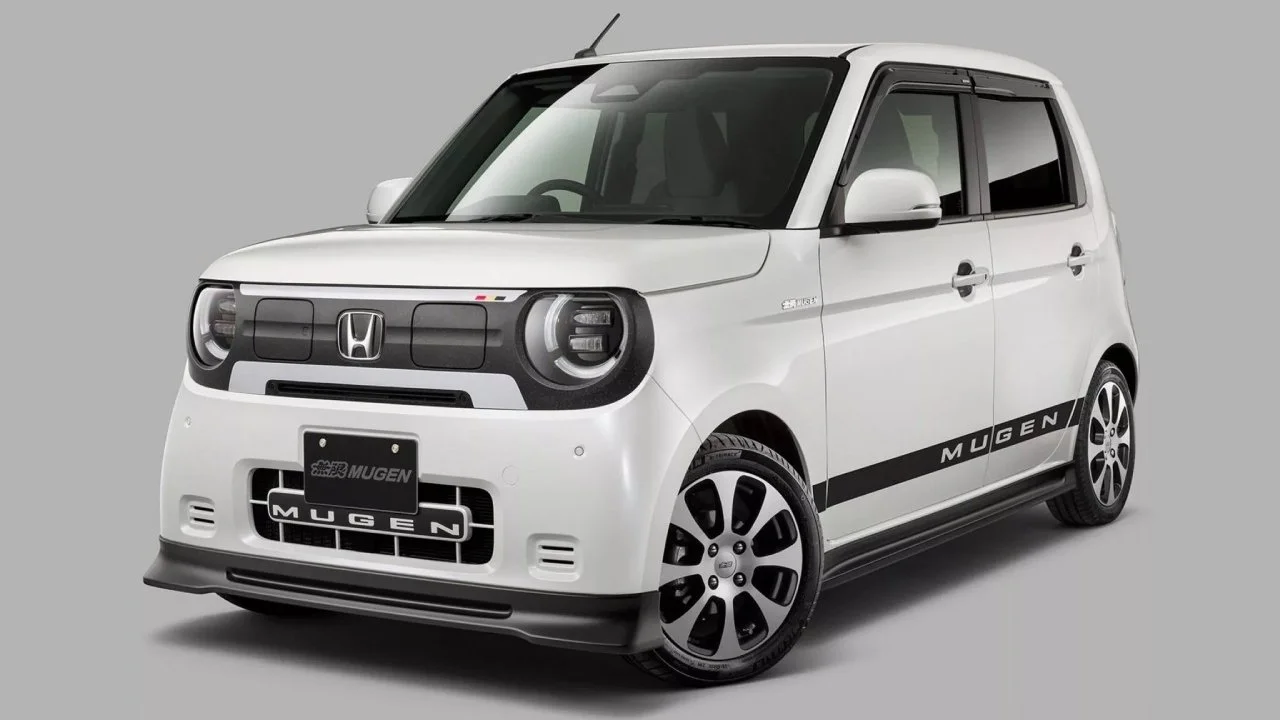
Every so often, a car company, or in this case, a legendary tuner, does something so wonderfully pointless that you can’t help but stand up and applaud. This is one of those moments. I’ve seen tuners slap wild body kits and massive wings on cars with engines powerful enough to alter the Earth’s rotation. But now, we’re in the electric age, an age of silent, sensible, and sometimes soul-crushingly dull transportation pods. Or so I thought.
Then, a file landed on my desk about what Mugen has done to Honda’s new N-One e:. For those not in the know, Mugen is to Honda what fire is to a good steak – an essential element for making things more exciting. They are the wizards who have historically blessed Civics and Integras with go-faster magic. And the Honda N-One e:? It’s a “kei car,” which is Japan’s answer to a question nobody in America asked: “How can we make a car the size of a large refrigerator?”

Image Credit: Honda.
The standard N-One e: is a tiny, all-electric cube designed for the impossibly crowded streets of Tokyo. It’s charming in a pug-like way, with big, round headlights that give it a perpetually surprised expression. And under its diminutive hood – if you can even call it that – is an electric motor producing earth-shattering… 63 horsepower. That’s right, sixty-three. My lawnmower is currently looking over my shoulder and having a good chuckle.
So, what does a legendary performance tuning house do with a 63-horsepower electric shoebox? The only logical thing, of course. They give it the full street-fighter treatment. It’s a similar idea to putting a tactical vest and night-vision goggles on a hamster. It makes no sense, and that’s precisely why it’s fantastic.

Image Credit: Honda.
Let’s start with the visuals. Mugen has bolted on a complete aero kit. There’s a new front splitter, which I assume is critical for keeping the front end planted during those blistering 0-to-30 mph sprints. It’s flanked by new side skirts that give the car a lower, more menacing stance. And out back, there’s a rear diffuser that looks like it was stolen from a pint-sized Le Mans prototype. All of this is finished in a very serious matte black.
Topping it all off is a rear spoiler. Now, on a supercar, a spoiler generates downforce to keep it glued to the road at 200 mph. On the Mugen N-One e:, I can only assume its purpose is to provide a convenient place for pigeons to rest. The whole look is completed by a set of gorgeous 15-inch alloy wheels. They look absolutely massive on this little guy, giving it the posture of a bulldog who’s just been told he’s a very good boy.

Image Credit: Honda.
Of course, a proper tuner car isn’t just about the plastic bits; it’s about letting everyone know who’s responsible for the madness. Mugen offers a catalog of decals so you can plaster their name all over the bumpers, grille, and side panels. There’s even a special badge for the front fenders, just in case the other five logos weren’t enough. It’s the automotive peacocking at its finest.
You’d think with all this aggressive aero, Mugen would have added some power. You would be wrong. The powertrain remains completely standard. You still get all 63 of those electric ponies. However, Mugen has fitted “performance dampers.” Yes, performance suspension to manage the monumental forces generated by a motor less powerful than some blenders. Paired with the bigger wheels, they promise more “responsive handling,” which should make your trip to the grocery store feel like a qualifying lap at Suzuka.
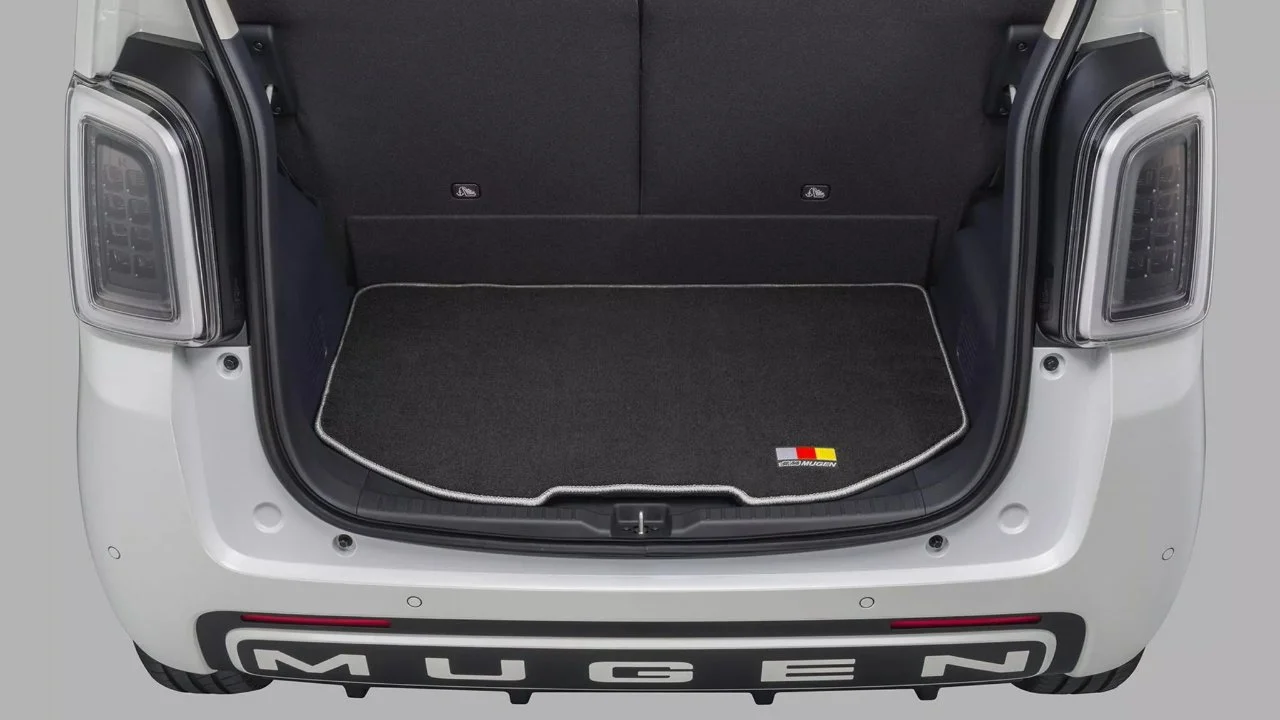
Image Credit: Honda.
The only thing holding you back from setting neighborhood speed records is the battery. Honda estimates the range to be over 145 miles, which is more than enough for a car like this. You’re not going to be doing cross-country road trips in it. Its natural habitat is the urban jungle, where its biggest challenge will be finding a parking spot small enough to do it justice.
Inside, the rampage of branding continues. Mugen will sell you scuff plates with their logo, special floor mats with their logo, and even liners for your door cubbies, presumably also with their logo. But there are also some surprisingly sensible items, like window visors for a bit of fresh air in the rain and hydrophilic mirror coatings to help with visibility. See? It’s not all fun and games; there’s a whisper of practicality in there somewhere.

Image Credit: Honda.
This whole package is, in a word, absurd. It’s a solution to a problem that never existed. And yet, I am completely smitten. It’s a rolling piece of evidence that the spirit of car culture – the fun, the silly, the “just because we can” attitude – is alive and well in the electric era. It proves that you don’t need 1,000 horsepower to have a car with personality. Sometimes, all you need is 63 horsepower and a very, very optimistic body kit. Bravo, Mugen. Bravo.